

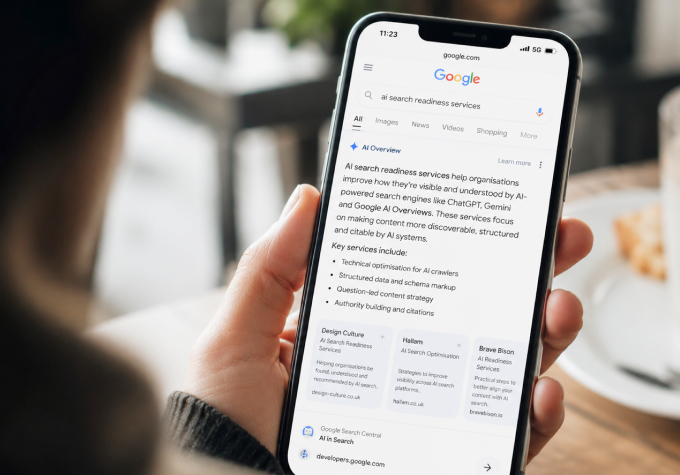
Search is changing faster than at any point in the last twenty years. A growing share of your audience no longer types a query into Google and scans a page of blue links – they ask ChatGPT, Claude or Google Gemini a question and get a single, synthesised answer. Google itself now places AI Overviews above traditional results for a huge proportion of searches.
For any organisation that depends on being discovered online – whether you’re a charity raising awareness of your cause, a cultural organisation promoting a programme, or a business selling through an ecommerce store – this shift raises an urgent question: when an AI answers on your behalf, is it citing you, or your competitor?
The good news is that AI search visibility isn’t a dark art. It builds on solid SEO foundations, with some new disciplines layered on top. This guide explains what’s changed, and what it takes to get your website ready for AI search.
What is AI search – and what are GEO and AEO?
You may have seen a cluster of new acronyms appearing alongside familiar old SEO:
- AI search is the umbrella term for search experiences powered by large language models – ChatGPT search, Google’s AI Overviews and AI Mode, Gemini, Perplexity, Claude and Microsoft Copilot.
- Generative Engine Optimisation (GEO) is the practice of making your content and brand visible within AI-generated answers – being cited, quoted and recommended by these tools.
- Answer Engine Optimisation (AEO) is a closely related idea: structuring content so it directly answers the questions people actually ask.
The critical difference from traditional SEO is this: search engines used to send people to your website; AI search engines increasingly answer on your website’s behalf. Your goal is no longer just to rank – it’s to be the source the AI trusts, cites and links to.
That matters commercially. Someone asking an AI assistant “which agencies build accessible websites for charities?” or “what’s the best platform for a small ecommerce store?” is often much closer to a decision than someone casually browsing. AI search traffic tends to be smaller in volume but far higher in intent.
Kristen Streten, Director at Design CultureWhen someone asks ChatGPT or Gemini a question your organisation should be the answer to, you're either cited or you're invisible – there's no page two. Getting AI-search ready now is the cheapest that visibility will ever be.
Does traditional SEO still matter?
Yes – and it’s worth saying clearly, because there’s plenty of hype suggesting otherwise. AI search engines lean heavily on the same signals as conventional search: crawlable pages, fast load times, authoritative content and a healthy backlink profile. Strong performance in Google tends to carry over into Gemini and AI Overviews in particular.
Think of it this way: SEO gets you into the library; GEO gets you quoted in the essay. You need both.
1. AI crawlers need to be able to read your website
This is the least glamorous factor and the most commonly fumbled one. Before an AI system can cite your charity, your museum or your online shop, its crawlers need access to your content – and a surprising number of websites are blocking them without anyone having decided to. Cloudflare, which a huge number of websites sit behind without realising, now blocks AI crawlers automatically unless told otherwise, and security and speed plugins can quietly do the same.
There’s a second, subtler problem: content that only appears after JavaScript runs is invisible to many AI crawlers, so a site can look complete to a human and half-empty to an AI. Add in the technical housekeeping signals AI systems use to judge whether your content is current and trustworthy, and there’s a genuine audit’s worth of checks here – most of which can’t be seen by looking at the site. It’s the first thing we assess, and it’s where we most often find organisations invisible through no fault of their content.
2. Answer real questions, directly and early
AI search engines are answer machines, so the content that gets cited is content built around answers. That means question-led headings – “How much does a charity website cost?” will surface in AI answers far more readily than “Budget considerations” – and pages structured so that each section directly answers something a real person would ask, in the language they’d actually use. A charitable organisation’s supporters phrase things differently to a procurement team, and AI assistants are asked questions conversationally, so that phrasing matters more than it ever did for Google.
Getting this right across a whole site is a content-structure exercise as much as a writing one – which questions to answer, where, in what format, and how features like FAQ content should be deployed page by page. That’s the editorial half of the audit.
3. Use structured data to tell AI what your content is
Schema markup – structured data added to your pages – is how you label your content in a machine-readable way, and it has become significantly more important in the AI search era. Which schema types matter, and how they should be implemented, depends on what kind of organisation you are: an ecommerce store, a charity and a membership body each need quite different markup. For charities and non-profits especially, well-implemented organisational markup helps AI systems represent you accurately – which matters enormously when the “answer” is the first and possibly only impression a potential supporter gets. Done wrong or left half-done, it’s worse than absent; it’s one of the things we review and specify precisely in an audit.
4. Include specific, citable facts
Research into generative engine optimisation has found that content containing specific statistics, named sources and verifiable claims is cited substantially more often by AI systems than vague equivalents. “Many people now use AI to search” is not citable; “37% of consumers now begin their research with an AI tool” is.
Organisations often sit on genuinely citable data without realising it – impact reports, survey results, project outcomes. Part of getting AI-search ready is finding that material and putting it to work.
5. Build authority beyond your own website
AI systems don’t judge you on your website alone. They cross-reference your organisation across the wider web – press coverage, sector directories, reviews, industry publications, even Reddit threads. A website with excellent content but no external footprint reads to an AI as an unverified claim.
For charitable organisations this is often a hidden strength: media coverage, umbrella-body listings and partner mentions are exactly the third-party signals AI systems trust. Knowing how AI tools currently see and describe your organisation is the starting point for strengthening it.
6. Depth beats one-off posts
When an AI answers a complex question, it breaks it into sub-questions and searches each one. An organisation with a connected cluster of content – a guide, a costs article, a how-to, an FAQ – can be cited multiple times in a single answer. One orphaned blog post can be cited once, at best.
This is why a proper website content strategy matters more in the AI era, not less: depth and internal linking are now visibility mechanics, not just editorial nice-to-haves.
7. Try it yourself
Here’s a five-minute experiment worth doing today: ask ChatGPT or Gemini the questions your audience asks – about your cause, your sector, your services – and see whether your organisation appears, and how it’s described. For many organisations the result is sobering: absent entirely, or described inaccurately from stale information.
Measuring AI search visibility properly – and moving it – is newer, harder territory; there’s no established toolset yet, and anyone claiming precise “AI rankings” is overselling. But that five-minute test will tell you whether you have a question worth asking us.
Where to start
If this feels like a lot, the honest summary is: get the foundations right first. A technically sound, fast, accessible website with genuinely useful, well-structured content is already most of the way to AI search readiness – whether you’re a charity, an arts organisation or an ambitious ecommerce brand.
At Design Culture we’re helping organisations audit and improve how they show up in AI search, from crawler access and structured data through to content strategy. If you’d like to know where your website stands, take a look at our AI-search readiness service or get in touch for an informal chat.
FAQs – the questions clients are asking us most frequently
Is AI search replacing Google? Not yet – but it’s changing how Google works. AI Overviews now sit above traditional results for many queries, and a growing share of research starts in tools like ChatGPT and Gemini. The organisations that adapt early will be the ones AI systems learn to cite.
Do I need a new website to optimise for AI search? Usually not. Most AI search optimisation involves improving what you have. If your site has deeper technical problems, though, AI search readiness is a strong reason to address them – see our guide on rebuilding vs overhauling your website.
Does AI search matter for charities and non-profits? Very much so. When someone asks an AI assistant which charitable organisations work on a cause, or whether a charity is trustworthy, the answer is drawn from how well that charity’s web presence is structured and corroborated. Being absent from those answers is a real cost in awareness, donations and reach.
How long does it take to see results? Like SEO, it’s cumulative. Technical fixes can influence visibility within weeks; authority and content depth build over months. The key is to start measuring now so you can see the trend.
