

A good website brief is the highest-leverage document your organisation will produce in the whole project. It shapes which agencies respond, how accurate their proposals are, how comparable their quotes are – and, more than anything else you control, how well the finished website matches what you actually need. A vague brief doesn’t save time; it defers every hard question to the most expensive possible moment to answer it.
The good news: writing a strong brief is not about knowing web technology. It’s about being clear on your organisation, your audiences and your goals – things you know better than any agency ever will. This guide covers what to include, what to leave out, and the mistakes we see most often. There’s a free website brief template to download at the end.
What is a website brief?
A website brief is a short document – typically four to eight pages – that tells prospective agencies what your organisation does, what you need your website to achieve, who it serves, what’s in scope, and the practical constraints: budget, timeline and how you’ll decide. It’s the foundation for accurate, comparable proposals, and later becomes the reference point the whole project is measured against.
You may see it called other things: a website design brief, a tender document, or a request for proposals (RFP). They describe broadly the same thing, though “tender” and “RFP” are usually reserved for a more formal procurement process with fixed scoring criteria.
Why does the brief matter so much?
Three practical reasons:
Comparable quotes If five agencies each interpret a vague brief differently, you’ll receive five proposals for five different projects – and the price differences will tell you nothing. A clear brief means the quotes describe the same work, so you can genuinely compare value.
Better agencies respond Good agencies read briefs the way employers read CVs. A clear, honest brief signals an organisation that will be good to work with, and attracts stronger responses. A muddled one attracts either no response from the agencies you’d want, or optimistic guesswork from the ones you wouldn’t.
Fewer surprises later Most painful moments in web projects – scope disputes, budget overruns, “we assumed you meant…” – trace back to something the brief left unsaid. An hour spent on the brief saves days in month four.
What to include in a website brief
Ten sections, in the order agencies find most useful:
- About your organisation Two or three paragraphs: what you do, who for, and what makes you distinct. If you’re a charity, name the cause and the change you exist to make – purpose-led agencies will respond to it. Link to your strategy if you have one.
- Why now What’s prompting this project? A dated site, a rebrand, a merger, content you can’t manage, an ecommerce ambition, falling donations or enquiries? The trigger tells agencies what success needs to fix.
- Your audiences List them honestly and in priority order – service users, donors, members, audiences, customers, funders, jobseekers, journalists. For each: what do they come to the site to do? This single section shapes information architecture more than any other.
- Goals and how you’ll measure them “A modern website” is not a goal. “Increase online donations by 25%”, “cut content-editing time for our small team”, “sell tickets without a third-party platform’s fees”, “meet WCAG 2.2 AA accessibility” – these are goals an agency can design towards and you can evaluate against.
- Scope – what’s in and what’s out Roughly how many page types? Is ecommerce or donations in scope? Multilingual content? A members’ area? Events? Analytics? Just as valuable: name what’s explicitly out of scope, so nobody prices for it.
- Content: the honest picture Who is writing, migrating or editing content, and how much exists today? Content is the most underestimated part of every website project – say plainly whether you need help with it, because it materially changes both price and timeline.
- Your current ecosystem, and what the site must integrate with This is one place where being technically specific genuinely helps. Map what you already run – CRM, email marketing platform, donation processing, payment gateways, box office or booking systems, finance tools, events platforms – and say which of them the new site must connect to, which are staying regardless, and which are up for review. You don’t need to know how an integration works; you do need the agency to know your ecosystem exists, because it materially shapes both approach and price.
- Design and brand Do you have brand guidelines, or is brand work part of the ask? You could list two or three websites you admire and – more usefully – say why.
- Practical constraints Budget (see below), deadline and what’s driving it, who the decision-makers are, and any procurement requirements. If accessibility, sustainability or data residency matter to your organisation, say so here – they’re requirements, not nice-to-haves.
- The process How to respond, by when, in what format, how you’ll shortlist, and when you’ll decide. Say how many agencies are receiving the brief and how they were chosen – publicly advertised, or sent to a pre-selected shortlist of however many. This transparency costs nothing and changes how seriously agencies can commit to responding. Build in time for a clarification conversation with each shortlisted agency before proposals are due – more on why below.
Should you include your budget in a website brief?
Yes, always. Withholding the budget doesn’t get you a better price; it gets you proposals scoped blind. A website brief with a budget range lets each agency tell you honestly what’s achievable for it – which is the conversation you actually want. If you genuinely don’t know what’s realistic, say that and give the range you have in mind; any good agency will tell you straight if the ambition and the number don’t match. (This is exactly why “how much should a website cost” deserves its own article – and it’s coming to our journal soon.)
Describe problems, not solutions
The most common brief-writing mistake is specifying the solution instead of the problem. “We need a mega-menu and a carousel” closes down the thinking you’re paying an agency for; “our audiences can’t find our services within two clicks” opens it up. The same applies to platforms – with one important exception to the rule: be completely honest about where you stand on CMS choice.
If you have a preference, state it and why – many organisations rightly ask for WordPress because their team knows it and it avoids being locked into proprietary systems. If it’s genuinely undecided, say so and name which platforms are in play, or state any you’ve already ruled out.
What wastes everyone’s time – yours included – is a brief that says “open to recommendations” when a decision has quietly been made: agencies invest days proposing a platform that was never really on the table, and you spend your evaluation comparing proposals that could never have won. Honesty here costs nothing and buys you better responses. If you’re genuinely weighing platforms, our guide to choosing the right CMS is written for exactly this moment.
The exception is genuine requirements: accessibility standards, integrations with systems you already run, compliance obligations. Specify those precisely.
Include questions you want every agency to answer
A short list of direct questions in your brief does two jobs: it makes responses genuinely comparable, and it filters for the agencies whose values match yours. Worth asking:
- How will you make the site accessible – and to what standard?
Any agency worth shortlisting will have a specific answer, not a promise. - How do you approach sustainable, low-carbon web design?
Page weight and efficiency are increasingly part of responsible digital – and they’re good for performance too. - How will the site be set up for AI search?
A current question few briefs ask yet: a growing share of your audience will find you through ChatGPT, Gemini and Google’s AI Overviews, and the technical and content decisions that affect that visibility are made during the build. (Our guide to optimising your website for AI search explains what’s involved.) - Who will actually work on our project?
Meet the team, not just the pitch team. - What does support look like after launch?
A website is never finished at launch – ask how updates, security and continual improvement are handled.
One etiquette note that good agencies will thank you for: don’t ask for free design work as part of the tender. (Watch this Speculative mock-ups produced without discovery tell you nothing about how an agency really works – judge responses on thinking, relevant experience and chemistry instead.
Common website brief mistakes
- The wish-list brief – every stakeholder’s ideas included, none prioritised. Agencies can’t price a wish-list; they can price priorities.
- The silent budget – covered above. Blind proposals help nobody.
- The forgotten content – assuming content “will be sorted” internally. It’s the most common cause of late launches, and worth an honest sentence in every brief. (It’s also a strong argument for improving the site you have rather than starting again – see do you really need a new website?)
- The borrowed requirements list – copying technical requirements from another organisation’s tender or a template found online. Agencies can tell when the requirements don’t match the organisation, and pricing for things you don’t need inflates every quote. If you don’t know whether you need a requirement, leave it out or ask the question instead.
- The invisible decision-maker – a brief written by one team, decided by another. Name who chooses and involve them before the brief goes out, not after proposals come in.
How to choose which agencies get your brief
A brief is only as good as its shortlist – and the best way to build one is to look hard at agencies’ actual work. Spend time on their websites and case studies, and on the live sites they’ve built: you’re looking for evidence of four things – creative quality, strategic thinking, a clear process, and technical delivery – ideally with results attached. Many of the best shortlists start exactly this way: seeing a website you admire, finding out who built it, and going from there.
One honest caution as you do this: don’t over-weight exact sector match. “They’ve done three organisations just like us” feels reassuring, but it tells you an agency can repeat a pattern – not that they’ll do their best work for you. What matters is whether their work shows they understand audiences and goals like yours: a donation journey and an ecommerce checkout are the same discipline, a membership scheme and a subscription business likewise. There’s a strong argument that an agency with cross-sector range brings you something a sector specialist can’t – approaches proven somewhere your competitors haven’t looked.
Recommendations and directories then round out the shortlist. Personal recommendations from organisations you trust remain the best source. For charities and non-profits, Dovetail – the Catalyst-backed directory of tech-for-good agencies – is a useful starting point, and communities like CharityComms and CharityConnect are good places to ask. For arts and cultural organisations, the Digital Culture Network offers free guidance and one-to-one support to those eligible for Arts Council England funding.
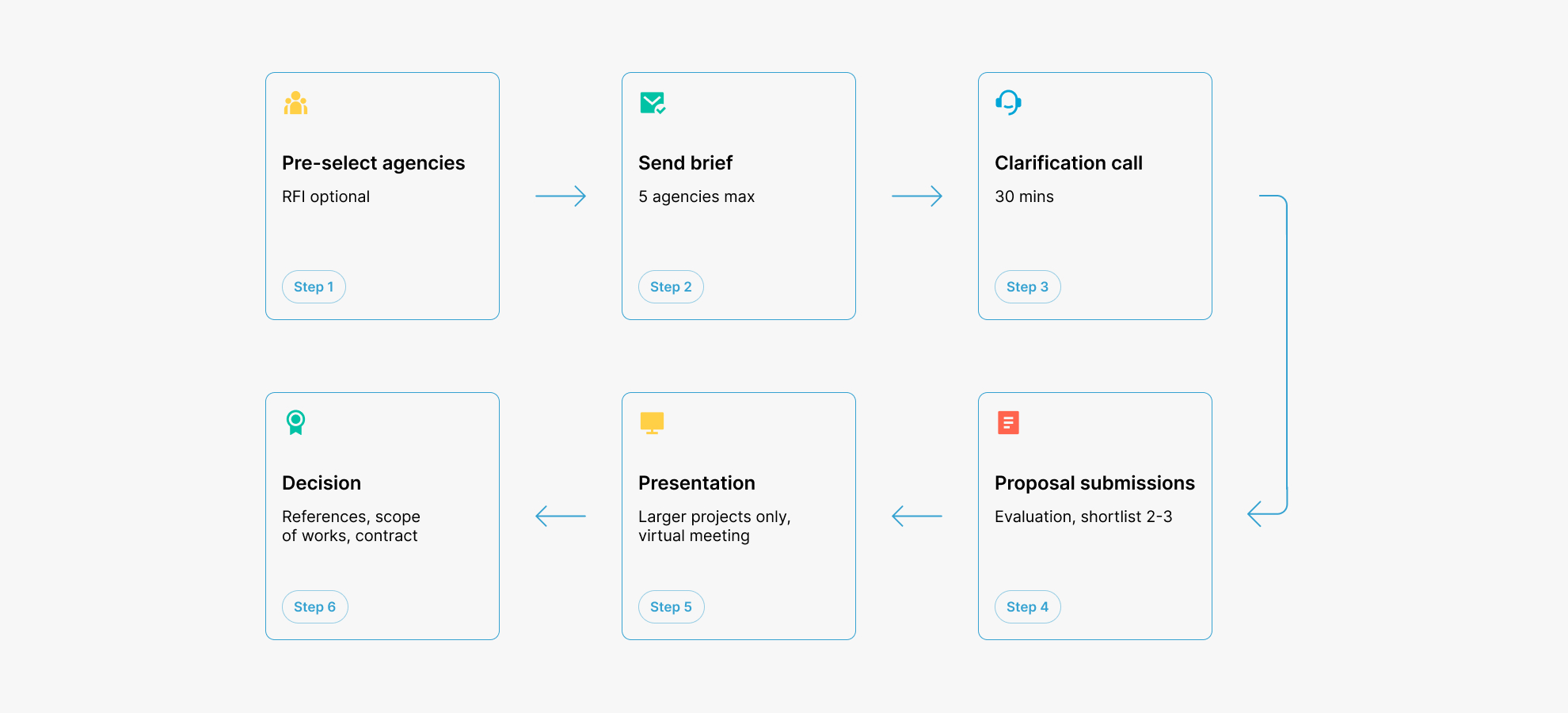
Pre-qualify first, then send the full brief to five agencies at most
If you’re starting from a long list – or advertising publicly – don’t send the full brief to everyone. Careful pre-selection pays off: look properly at agencies’ work, case studies and clients, and shortlist the ones that clearly fit.
Where you want more evidence, ask for a one-page RFI (request for information) or even a quick response on email: relevant experience, comparable projects, team, indicative budget fit. It takes each agency an hour, takes you minutes to review, and gets you to a genuine shortlist quickly.
Then send the full brief to no more than five. This isn’t just courtesy to agencies – though it is that; a full proposal is days of unpaid work, and strong agencies increasingly decline tenders where the odds are one in twenty. It’s mostly self-interest: twenty proposals means twenty different interpretations to read, score and compare, which is weeks of your team’s time producing a worse decision than five thoughtful responses would. The best procurement processes we see are narrow and deep, not wide and shallow.
Then talk to your shortlist before they write a word
Once shortlisted agencies have the brief, offer each a short clarification meeting or call before proposals are due. This is the single most valuable half-hour in the whole process, for both sides: the questions an agency asks tell you more about how they think than any polished document will, you get an early read on chemistry while there’s still time for it to matter, and the proposals that come back respond to your actual situation rather than to assumptions. Save the formal presentation and Q&A for after proposals are in, when you’re choosing between your final two or three.
