Technologies and integrations
- WordPress Multisite
- WordPress
- Cloudinary
- Gravity Forms
Enable
Enable had been delivering leisure, culture, health, parks and community services, reinvesting every penny of surplus back into the communities it served. It’s work was good. The impact was real. But its brand and digital presence was telling almost none of that story.


Enable had a brand and website problem – and the two were deeply connected.
The organisation was communicating to fundamentally different audiences (B2B clients, commissioners and funders; and B2C service-users and the general public) through a single, poorly structured website, and a brand largely shaped by its council partnership rather than Enable’s own identity.
The brand’s complexity was real: at any given moment, Enable might need to lead communications, play a supporting partner role, co-present with NHS or Macmillan, or step back behind a sub-brand like Battersea Park Weddings or Putney School of Art & Design – yet no framework existed for navigating this. The result was inconsistency, missed opportunity, and a growing disconnect between the quality of Enable’s work on the ground and how it presented itself to the world.
Positioning with purpose
We began with a substantial discovery phase – conducting interviews and group sessions across the business. This gave us a rounded picture of how people inside Enable understood the organisation, what they were proud of, where the tensions lay, and what they needed the brand to do. It also surfaced the business’s ambitions.
From this insight, we developed a clear strategic positioning for Enable – articulating its purpose, its differentiated value as a not-for-profit reinvesting in communities, and the tone and character to define how it communicates – including a new positional strapline:
Enable. For happy, healthier communities. Not for profit.



Visual Identity
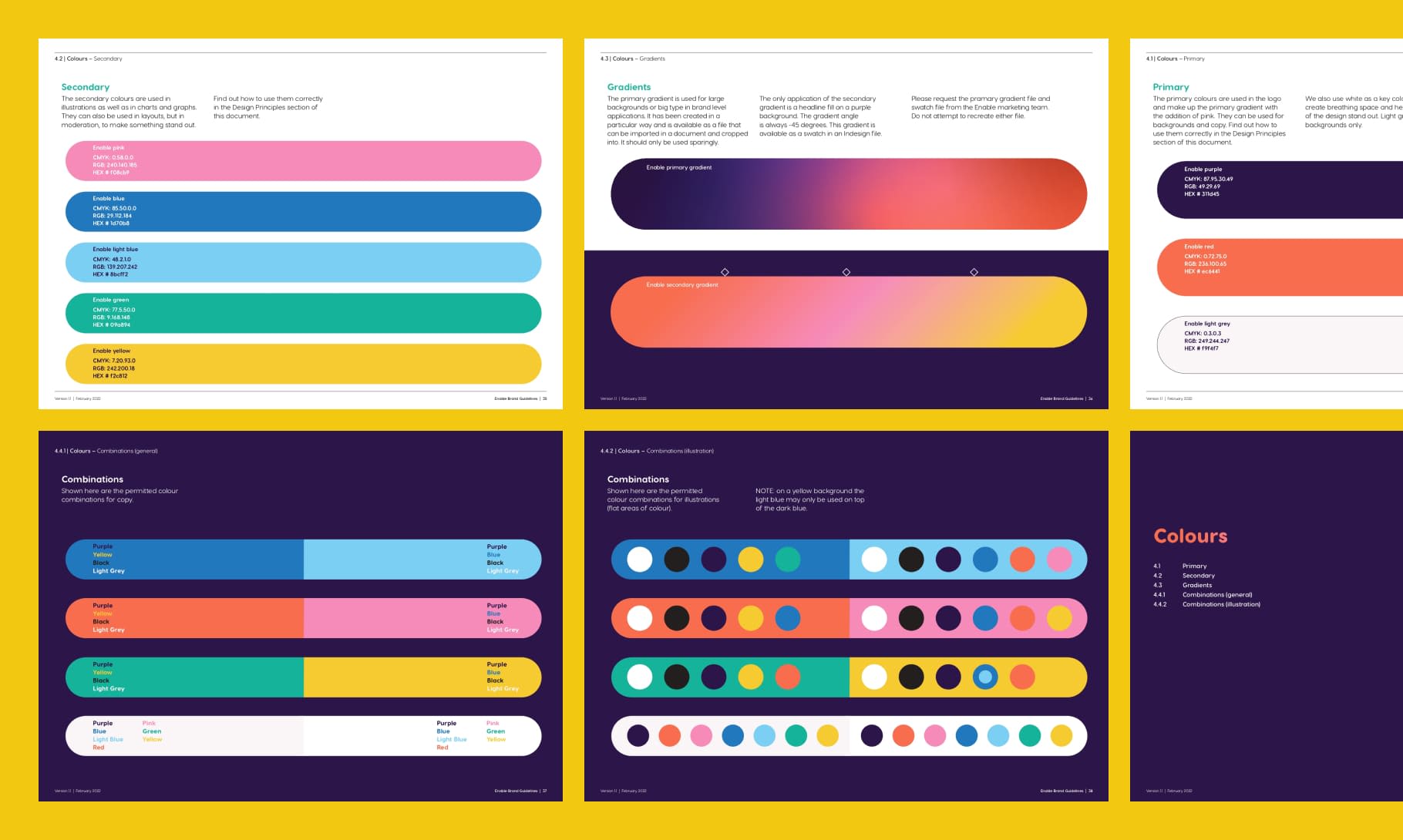
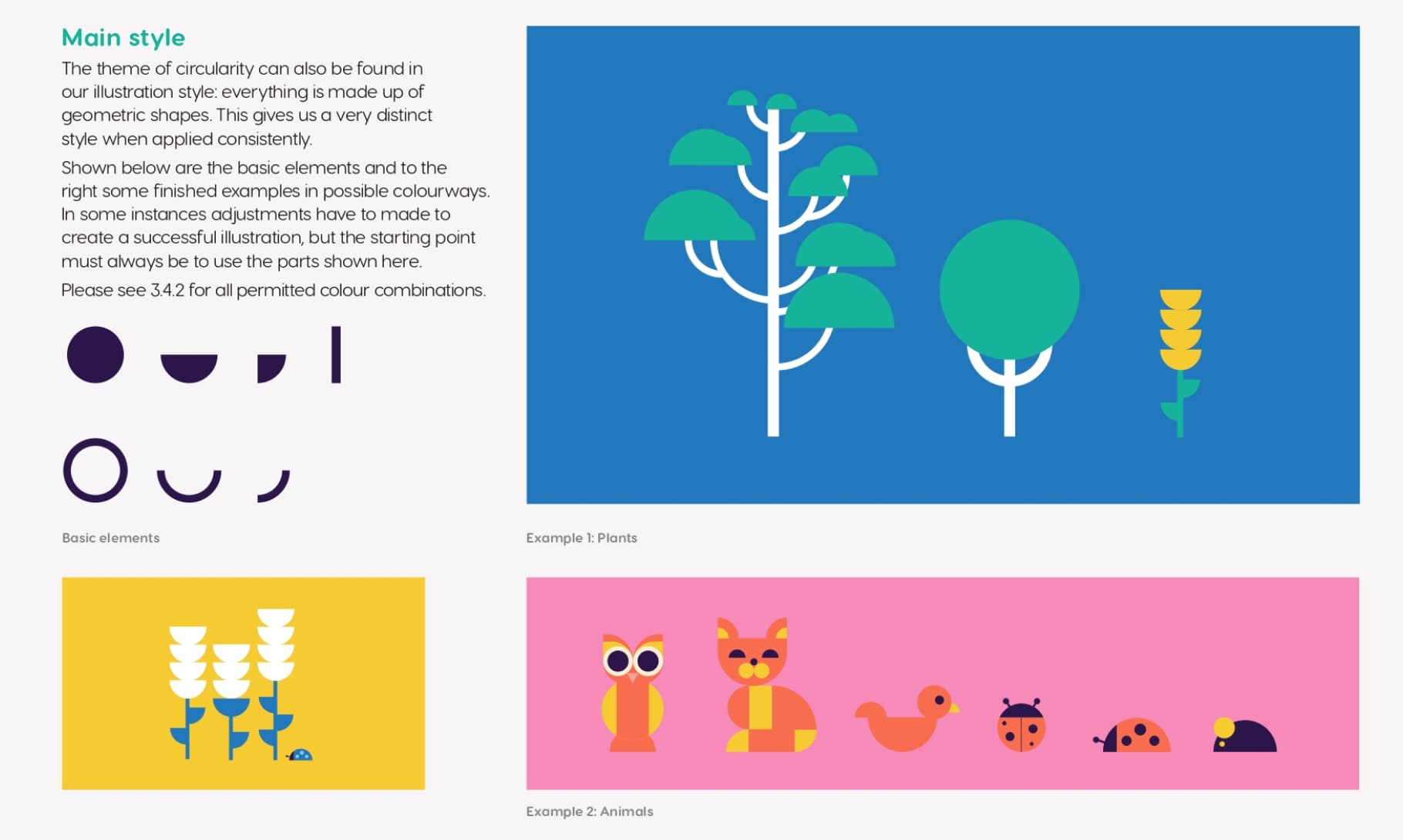
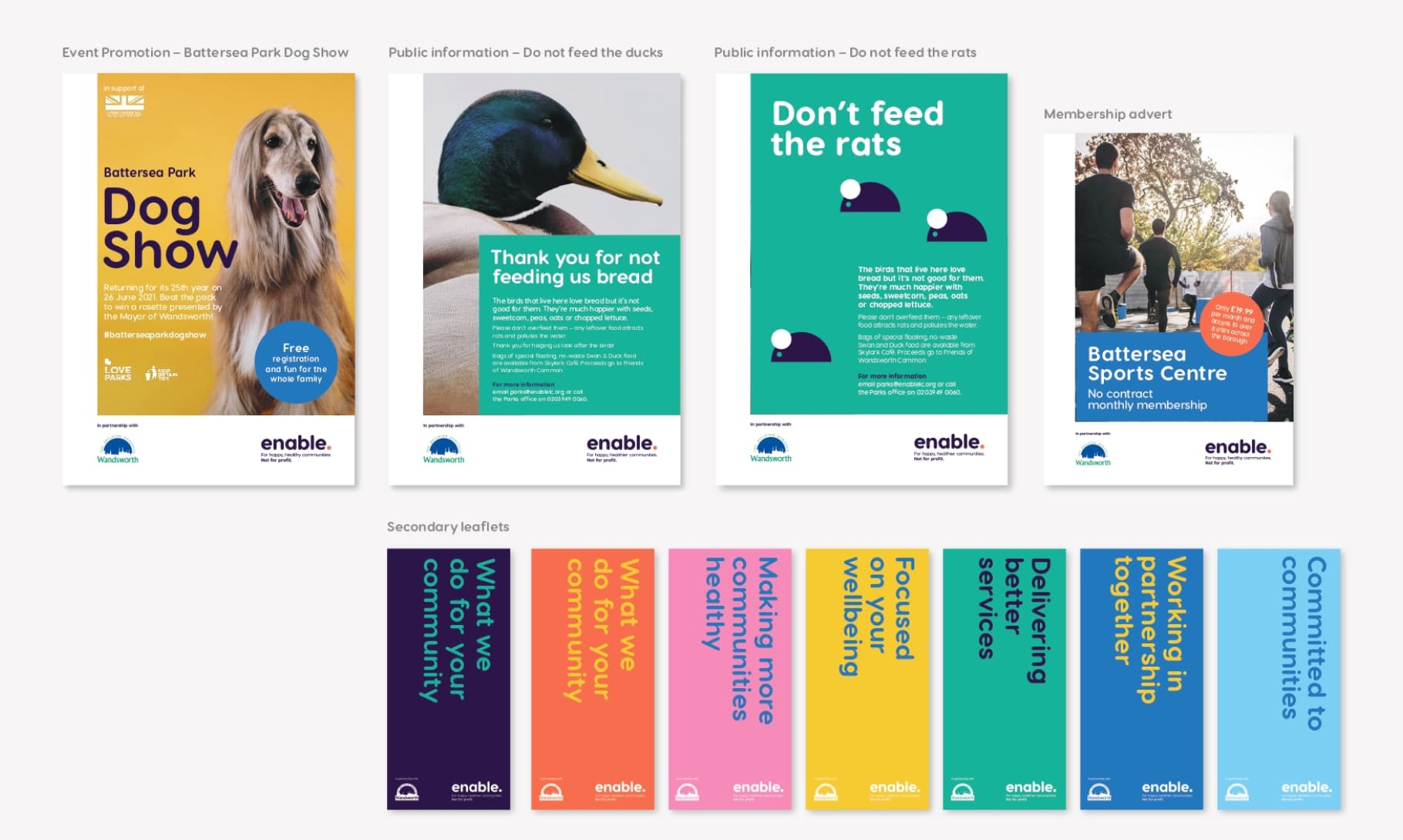
The geometry of the new logo is inspired by circularity – communicating the continual reinvestment that sits at the heart of everything Enable does. The full stop adds weight and purpose, a quiet declaration of intent. Deep purple anchors the identity, conveying trust and responsibility, while a paired red brings warmth and energy. A wider secondary palette – bright and optimistic – was introduced to give the brand range, designed to be deployed with particular purpose across B2C communications and event collateral. Two vibrant gradient fills add a dynamism when it’s needed, while warm, human, colour-rich photography and bespoke illustration and iconography – each drawing on the rounded language of the logo – bring the whole system to life.
Communicating partnership delivery
One of the most critical outputs was establishing the right brand architecture. We developed a framework for visual and language communication that could be dialled up or down to place emphasis on Enable or the Council across different services and outputs – providing the right level of partner recognition without cost to Enable. Alongside this, we created a simple and robust brand toolkit to ensure consistent application across all communications.




Efficient, cost-effective WordPress delivery – for both B2B and B2C
The existing site was attempting to serve corporate clients and general service-users simultaneously from a single platform, doing neither well. Navigation was confused, content and functionality was out of date, and the user experience was poor. Many service areas had effectively stopped using it as a communications and engagemtns tool.
Our recommendation – borne out clearly by Discovery – was to create two distinct digital solutions: a focused B2B corporate site to drive business development and communicate Enable’s purpose and impact to commissioners, funders and partners; and a B2C solution to drive engagement and uptake, designed as a flexible platform with templates that could be efficiently re-skinned and deployed for each client contract as Enable grew.
The sites were built bespoke on WordPress Multisite, with the architecture deliberately designed to minimise redesign and development effort for future deployments, delivering big cost-savings over time.
Both sites were built to reflect the new brand – translating the visual identity into a digital experience that was audience-led, brand-building, and designed to convert: clear information architecture, simple user journeys, strong calls to action, and the ability to cross-pollinate between service areas to grow awareness of Enable’s full offer.